
Key highlights
- Understand who must comply with Oman WPS regulations
- Learn the core rules governing salary payments and reporting under the Oman WPS
- Identify critical deadlines to avoid compliance violations
- Recognize penalties that impact operations and workforce stability
- Discover practical strategies to strengthen WPS compliance controls
Oman’s regulatory landscape is evolving rapidly and payroll compliance is no longer something businesses can afford to treat casually. The Oman wage protection system private sector framework is reshaping how salaries are processed, monitored and validated across businesses in the Sultanate.
Even minor payroll inaccuracies can trigger operational risks and reputational concerns. For growing businesses and established enterprises alike, understanding the broader compliance environment is essential to staying protected and future-ready.
In this guide, we will break down the rules, deadlines, enforcement mechanisms and practical strategies businesses need to stay fully compliant with the Oman Wage Protection System.
What is the Oman Wage Protection System?
The Oman Wage Protection System is a government-regulated framework that standardizes how private sector salaries are paid and reported. It requires employers to process wages through approved financial institutions rather than informal methods.
Payroll data is submitted electronically in a structured format, enabling authorities to verify accurate salary transfers. This system strengthens transparency and accountability in workforce compensation.
Understanding the scope of Oman WPS begins with identifying which businesses fall under its mandate.
Who must comply with the Oman Wage Protection System?
The applicability of WPS depends on business classification, workforce structure and registration status. Compliance is not limited to large corporations. Many small and mid-sized employers also fall within its scope.
Determining whether your entity is covered helps prevent regulatory penalties and operational setbacks:
- Private sector employers: All companies registered and operating in the Sultanate of Oman fall under the WPS mandate.
- Businesses with contracted employees: Organizations employing Omani nationals or expatriates under valid labour contracts must comply.
- Employers processing payroll: Salaries must be transferred exclusively through WPS-approved banks or authorized financial institutions.
- SMEs under labour oversight: Small and mid-sized enterprises are equally subject to the Ministry of Labour payroll reporting requirements.
Most active private sector employers are therefore expected to structure payroll in accordance with WPS mandates. Now let’s examine the specific rules that govern how the system operates.
What are the key rules of the Wage Protection System in Oman?
The Wage Protection System in Oman operates under defined regulatory requirements issued by the Ministry of Labour and coordinated with the Central Bank of Oman.
These rules are designed to ensure salary transparency, contractual accuracy and banking traceability across the private sector.
Key rules include:
- Mandatory enrollment: Private sector employers must register and process payroll through the WPS framework. Participation is compulsory once the system applies to the business.
- Electronic salary transfers: Wages must be paid through approved banks or licensed financial institutions within Oman. Cash payments are not recognized for compliance purposes.
- Salary Information File (SIF) submission: Employers are required to generate and submit a monthly SIF containing detailed payroll data. This enables digital validation of salary transfers.
- Contract-aligned payments: Salaries must reflect the agreed employment contract, including basic pay, allowances and approved deductions.
- Payroll documentation: Accurate payroll records must be maintained for regulatory review and audit requirements.
- Limited exemptions: Select categories, such as domestic workers or certain small businesses, may be exempt, subject to formal approval by the Ministry of Labour.
Adhering to these rules is only part of compliance. Timing plays an equally critical role. Thus, understanding when salary payments must be completed under the Oman WPS framework.
What are the deadlines for wage payments under the Oman WPS?
Timely salary payment is a central requirement under Oman’s Wage Protection System. Employers are expected to process wages within clearly defined timeframes to maintain compliance and avoid regulatory scrutiny.
Meeting deadlines is not merely administrative. It directly impacts a company’s compliance status.
Key timelines include:
- Monthly payment window: Salaries must be transferred within three days from the end of each wage cycle.
- Strict grace period: Delays beyond the permitted window may trigger non-compliance alerts.
- Bank-confirmed processing: Payment is considered complete only after successful transfer through approved financial institutions.
- Digital tracking: Wage transfers are electronically monitored for adherence to prescribed timelines.
Adhering to these deadlines strengthens payroll credibility and regulatory standing.
This leads to an important question: how do authorities monitor and enforce these timelines across businesses?
What role does the government play in WPS enforcement in Oman?
The enforcement of the Wage Protection System in Oman is led by the Ministry of Labour, in coordination with the Central Bank of Oman and licensed financial institutions.
The government’s role extends beyond policy issuance. It involves active monitoring, regulatory oversight and structured intervention where necessary to maintain payroll integrity across the private sector.
Key enforcement responsibilities include:
- Digital monitoring: Wage payments are tracked electronically through banking channels integrated with regulatory systems. This allows authorities to verify payment status and detect delays.
- Data validation: Submitted Salary Information Files are cross-checked against bank transfer records to ensure alignment with declared payroll data.
- Regulatory oversight: The Ministry reviews compliance patterns and may initiate inspections where irregularities are identified.
- Corrective measures: Employers may receive notifications or compliance directives if discrepancies are detected.
- Guidance and support: The Ministry provides procedural clarification and technical direction, particularly to SMEs adapting to digital payroll systems.
Through structured oversight and coordinated banking integration, the government reinforces transparency and accountability in wage payments. When compliance gaps arise despite these controls, the consequences can be significant.
What are the penalties for non-compliance with WPS in Oman?
Non-compliance with the Oman WPS can expose businesses to regulatory, financial and operational consequences.
Penalties are structured to protect employees while reinforcing payroll discipline across the private sector.
Key penalties for WPS violations:
- Monetary fines: Employers may face financial penalties for delayed wage transfers, inaccurate salary reporting or failure to submit required payroll files. The Ministry of Labor can issue warnings, block new work permits or fine 50 OMR per worker, doubling for repeated breaches. It makes timely and accurate payroll management essential.
- Suspension of labour-related services: Non-compliant companies may face temporary suspension of essential government services. This can include restrictions on new work permits, employment visa renewals and labour clearance processing. Such suspensions can disrupt workforce planning and project timelines.
- Operational restrictions: Continued non-compliance may lead to broader administrative limitations. Authorities may flag the company within regulatory systems, resulting in closer scrutiny of future filings and applications.
- Referral to legal proceedings: In cases involving repeated or serious violations, the matter may be escalated for judicial review. Court proceedings can result in additional financial liabilities or legally binding corrective measures.
- Increased regulatory monitoring: Companies with prior violations may be placed under enhanced compliance observation. This can lead to more frequent inspections and stricter evaluation of payroll submissions.
The penalties associated with WPS non-compliance are designed to enforce timely wage payment and accurate payroll reporting. They also serve as a safeguard for employee rights and labour market stability.
For employers, the impact extends beyond fines. Service suspensions and regulatory scrutiny can affect operational continuity and long-term business credibility.
Avoiding these consequences requires structured payroll processes and consistent compliance controls.
What are the best practices to stay compliant with the Oman WPS?
Maintaining alignment with WPS requirements calls for a proactive and detail-oriented approach. Compliance is not achieved through isolated actions. It depends on consistency, accuracy and well-managed payroll systems.
Organizations that adopt disciplined internal frameworks position themselves for smoother regulatory interactions and stronger workforce confidence.
Here are the key best practices for maintaining Oman WPS compliance:
- WPS governance: Establish a payroll framework aligned with Oman’s WPS requirements. Define internal responsibility for SIF preparation, validation and timely bank submission within the seven-day wage window.
- Salary Information File accuracy: Verify salary calculations, allowances and approved deductions before generating the Salary Information File. Ensure the SIF data matches employment contracts and approved payroll records.
- Contract compliance: Confirm that wage components reflect registered employment agreements under Omani Labour Law. Update payroll systems immediately when contractual amendments are approved.
- System automation: Use payroll software configured for Oman WPS formatting standards. Automated SIF generation reduces rejection risks and minimizes manual reporting errors.
- Documentation control: Maintain organized digital records of bank transfer confirmations and submitted SIF files. Proper documentation ensures readiness during Ministry of Labour reviews or compliance checks.
Strong WPS adherence depends on reliable systems, accurate reporting and consistent execution across payroll cycles. Gaps in process control increase compliance risk and administrative strain.
As regulatory expectations evolve, efficiency becomes just as important as accuracy. This is where the right payroll technology can create a measurable advantage.
How does infithra simplify Oman WPS compliance?
Managing Oman WPS requirements manually can strain internal resources and increase the risk of reporting errors. Our payroll management platform is designed to streamline compliance while maintaining accuracy and operational control.
By combining automation with regulatory alignment, infithra helps businesses process payroll efficiently within Oman’s Wage Protection System framework.
How infithra supports WPS compliance:
- Automated WPS file generation: infithra automatically creates Salary Information Files in the formats required for Oman WPS submission, including Excel, CSV and SIF. This reduces manual preparation time and minimizes formatting errors.
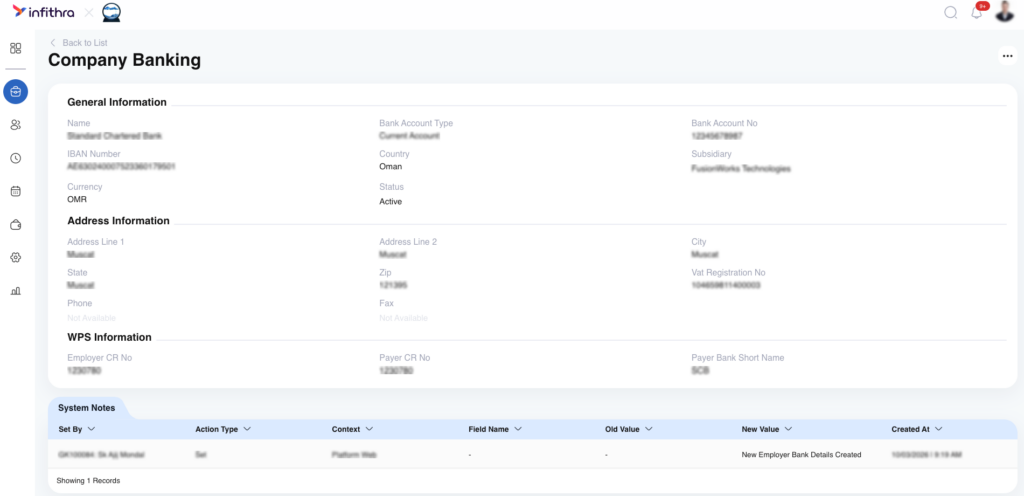
- Company Banking details for Oman WPS: infithra allows multiple bank accounts in the Company Banking section. If Oman is selected, employer details such as Employer CR Number, Payer CR Number, Payer Bank Short Name and Employer ID must be provided.
Refer to the screenshot below to see how these details are entered in infithra:
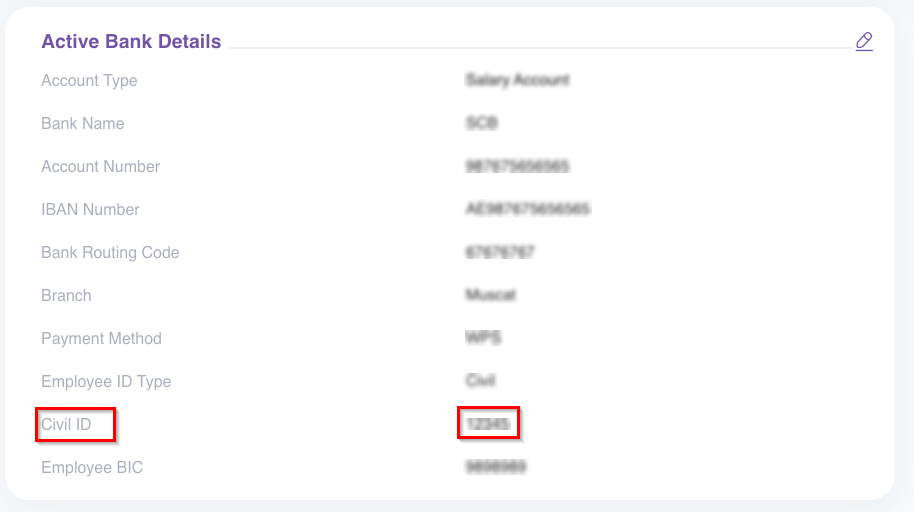
In the Employee Profile, select P (Passport ID) or C (Civil ID) to ensure correct Oman WPS file generation.
Refer to the screenshot below to see how the process works in infithra when you opt for C (Civil ID):
- Built-In compliance validation: The system performs structured checks before payroll finalization. This helps identify discrepancies in salary components, deductions or employee data prior to submission.
- Reduced rejection risk: Pre-configured payroll templates align with Oman’s reporting standards. Accurate file structuring lowers the likelihood of Salary Information File rejections or submission delays.
- Cloud-based audit trail: Secure digital records store payroll transactions, approvals and transfer confirmations. This simplifies documentation retrieval during regulatory reviews.
- Multi-country payroll capability: For organizations operating across Oman and the GCC, infithra supports centralized payroll processing within a unified platform. This ensures consistency while accommodating country-specific compliance requirements.
infithra transforms WPS compliance from a manual administrative burden into a structured digital process. Automated validation, secure record keeping and standardized reporting help businesses maintain payroll accuracy with confidence.
With the right technology in place, staying compliant becomes more predictable and far less complex.
Final thoughts
Oman’s Wage Protection System is a regulatory standard that demands accountability and structured payroll control. Organizations that implement reliable compliance systems reduce operational disruption and reinforce long-term workforce confidence.
Without the right processes in place, payroll management can become vulnerable to errors, delays and unnecessary administrative pressure. Replacing manual effort with structured automation brings greater accuracy, visibility and control.
If you are ready to automate payroll operations while strengthening your Oman WPS compliance framework, now is the time to act.
Schedule your free demo today and discover how infithra can automate, validate and safeguard your HR and payroll processes with confidence.

FAQs
1. What is the WPS in Oman?
Private sector employers must pay salaries electronically through approved banks and submit structured payroll reports for verification, ensuring timely payments and transparency. To manage this efficiently, businesses can utilize payroll platforms like infithra. It can help automate Salary Information File generation, validate payroll data and minimize submission errors within the Oman WPS framework.
2. What are the latest WPS compliance requirements from Oman’s Ministry of Labour?
Under Ministerial Resolution No. 729/2024, employers must pay at least 75% of staff via WPS from September 2025 wages, rising to 90% for November 2025. Non-compliance may lead to financial penalties. The resolution was published in the Official Gazette on 15 December 2024.
3. Who must comply with the Wage Protection System Oman rules?
All private sector companies registered and operating in Oman must comply with WPS requirements. This includes businesses employing Omani nationals or expatriate workers under valid employment contracts. Small and medium-sized enterprises are also subject to WPS regulations unless formally exempted by the Ministry of Labour.
4. Are there any exemptions from Oman’s WPS requirements?
Yes, certain cases are temporarily exempt from WPS. These include employees with less than 30 days of service, workers on unpaid leave, labour disputes causing work stoppage over 30 days, absconding employees after 30 days and work suspensions beyond the employer’s control.
5. How are salaries paid under the Oman Wage Protection System?
Under the Oman WPS, salaries must be paid electronically through approved banks or licensed institutions. Employers submit a standardized Salary Information File, which is cross-verified with bank transfers. Payroll software like infithra automates compliant files and validates payroll data before submission.
6. What is the deadline for salary payments under Oman WPS?
Employers must transfer salaries within seven days from the end of each wage cycle. Payments are considered complete only after successful processing through approved financial institutions. Delays beyond the permitted window can trigger compliance alerts and regulatory action.
7. What happens if an employer fails to comply with WPS in Oman?
Non-compliance can result in financial penalties, suspension of labour-related services and increased regulatory monitoring. Authorities may restrict work permit issuance or visa renewals for non-compliant companies. In serious or repeated cases, matters can escalate to legal proceedings under Oman’s Labour Law framework.
8. What is a Salary Information File in Oman WPS?
A Salary Information File is a structured electronic payroll report submitted monthly under the WPS framework. It contains employee salary details, including basic pay, allowances, deductions and bank account information. The file allows authorities to digitally verify that wages match employment contracts and bank transfers.
9. What is Article 72 of the Oman Labour Law?
Article 72 of Oman’s Labour Law requires employers to pay wages on the agreed date, as stated in the employment contract. It mandates regular payments without unlawful deductions. The Wage Protection System enforces this through digital payroll monitoring and bank-based verification.
Leave a Reply