
Key highlights
- Understand how TOIL supports structured and flexible workforce management in UAE organizations
- Learn how to define clear TOIL policies aligned with operational and role-based needs
- Explore how compliance requirements shape TOIL implementation across UAE businesses
- Identify operational gaps that limit efficiency in manual TOIL management processes
- Discover how automation improves visibility, consistency and control in TOIL workflows
In many UAE organizations, additional working hours do not always translate into paid compensation. Instead, employees may receive compensatory leave, commonly referred to as Time Off in Lieu (TOIL).
While the concept seems straightforward, managing TOIL can become complex. HR teams must track working hours accurately, apply internal policies consistently and ensure alignment with UAE labour regulations.
Without proper systems, approvals, leave balances and compliance records often become scattered across spreadsheets and emails. This lack of structure increases the risk of errors and delays.
As a result, TOIL has become a critical part of workforce management. When handled effectively, it helps organizations recognize extra work while maintaining operational efficiency.
Understanding TOIL and managing it efficiently is essential for modern HR teams. This guide explores key concepts, legal considerations and effective ways to streamline TOIL management in the UAE.
What is Time Off in Lieu
Both time off in lieu and compensatory leave (also called comp time) allow employees to take paid leave for extra hours worked. Instead of additional pay, organizations grant equivalent time off later. This approach recognizes additional effort while supporting flexible workforce management.
To manage this effectively, organizations usually define TOIL rules in internal HR policies. These policies outline eligibility, approval processes and usage timelines. Clear documentation helps prevent confusion and ensures consistency across teams.
Understanding the concept is only the starting point. The next step is seeing how organizations apply TOIL in daily operations.
How does Time Off in Lieu work in the UAE
In the UAE, Time in lieu begins when employees work beyond the standard 8-hour workday or 48-hour workweek, as defined under UAE Labour Law. Instead of additional pay, employers may offer equivalent paid time off, provided this arrangement is agreed upon in advance.
Organizations typically track these extra hours through attendance systems or timesheets. Since working hours are regulated in the UAE, the additional time must be formally approved by managers or HR to ensure compliance with labour requirements.
Once validated, the extra hours are converted into leave and credited to the employee. They can then request TOIL similarly to other leave types, subject to internal policies and business needs.
Many UAE-based companies also define a validity period for using TOIL (for example, within 30–90 days). This prevents the accumulation of unused leave and supports better workforce planning.
When structured clearly, TOIL supports better scheduling and workforce planning. It also creates measurable value for both employees and organizations.
What are the benefits of Time Off in Lieu for businesses and employees
Time Off in Lieu offers a practical way to manage additional working hours in a structured and flexible manner. When implemented correctly, it can support both operational efficiency and employee well-being, particularly in roles where work intensity fluctuates.
However, in the UAE, its effectiveness often depends on the nature of the role, industry and how clearly policies are defined.
Key benefits include:
- Flexible staffing during peak workloads: TOIL can help businesses manage high-demand periods, especially in industries such as retail, hospitality and events. Employees may work additional hours during peak times and take time off later when workloads stabilize. However, in shift-based or customer-facing roles, granting time off later may depend on staffing availability.
- Project-based workload recovery: In corporate, consulting and project-driven environments, TOIL allows teams to recover time after intensive work cycles. This is particularly useful for roles involved in real estate, event or deadline-driven projects. Its application may be less consistent in labour-intensive roles, where work schedules are less flexible.
- Reduced payroll volatility: Where permitted within company policy and labour regulations, TOIL can help manage short-term payroll fluctuations. It allows organizations to balance workforce costs while recognizing additional employee effort.
- Stronger employee engagement: Recognizing additional effort through time off can improve trust and satisfaction, particularly in the UAE’s multicultural workforce, where flexibility is valued. However, this benefit depends heavily on transparent policies and consistent approval processes.
To realize these benefits consistently, organizations need clear policies that define how TOIL is tracked, approved and applied, ensuring fairness across roles and alignment with business needs.
How is Time Off in Lieu calculated in the UAE
Accurate TOIL calculation ensures fairness and supports alignment with internal policies. In the UAE, organizations must also consider working hour limits and compensation requirements defined under the UAE labour regulations. A structured approach helps HR teams maintain clarity while staying compliant.
For example, a project team working extended hours during a product launch may accumulate additional time across several days. In some cases and where company policy allows, these hours may be converted into TOIL instead of direct payment. This typically applies to specific roles or mutually agreed arrangements.
The following steps outline a practical approach HR teams in the UAE can follow to calculate TOIL:
- Determine additional working hours: Begin by defining what qualifies as additional hours within your organization. In the UAE, standard working hours are typically 8 hours per day or 48 hours per week.
Time worked beyond this may qualify, depending on company policy and role eligibility. In general, additional working hours should not exceed 2 hours per day, except under specific circumstances permitted by law.
Use reliable tracking tools such as digital attendance systems or timesheets. These tools help record extra hours accurately. Employees should clearly understand whether their additional hours are eligible for TOIL, as this may vary by role or contract type. - Agree on the accrual rate: Next, define how additional hours convert into TOIL. Many organizations follow a 1:1 conversion, where one extra hour equals one hour of leave.
- Enhanced accruals may apply in certain situations, such as:
- Work on rest days
- Public holidays
- Extended or critical business hours
- Example conversion rates may include:
- 1 additional hour = 1 hour TOIL
- 1 additional hour = 1.5 hours TOIL for rest days or public holidays
- These variations should be aligned with internal policy and carefully reviewed against UAE compensation guidelines. Ensure the accrual policy is clearly documented and accessible to employees.
- Enhanced accruals may apply in certain situations, such as:
- Calculate the TOIL earned: Once additional hours and accrual rates are confirmed, apply a simple formula:
TOIL earned = Additional hours × accrual rate
For example, an employee works 8 additional hours during a project deadline. The organization applies a 1.25 accrual rate for extended shifts.
So, 8 × 1.25 = 10 hours of TOIL
The employee receives 10 hours of compensatory leave.
- Apply caps and validity limits: Most organizations define limits to control TOIL accumulation. This helps maintain workforce balance and prevents excessive leave build-up.
Common controls include:
- A maximum number of TOIL hours an employee can hold
- A defined timeframe to use the accrued TOIL
A clear calculation method keeps TOIL policies fair and easy to manage. Transparent rules also help employees understand how their extra effort converts into leave.
Accurate TOIL calculation is essential, but organizations must also account for UAE compliance requirements and the legal implications involved.
What are the legal considerations for Time Off in Lieu in the UAE
Organizations offering TOIL in the UAE must align their policies with national labour regulations. Compensatory leave should not conflict with additional work hour rules or employee rights defined by law.
HR teams must understand legal limits on working hours, compensation for extended working hours and recordkeeping before implementing any structured TOIL program.
Key legal considerations include:
- TOIL must align with statutory overtime work rules: Under Federal Decree Law No. 33 of 2021, additional working hours are generally compensated through overtime pay. While employers may offer TOIL as part of internal policies, it should not result in employees being deprived of legally mandated additional work hour benefits.
In certain cases, such as work on rest days or public holidays, the law permits compensatory time off/TOIL. HR teams must ensure TOIL policies remain compliant with employee entitlements.
- Daily extra work hour limits must be respected: UAE regulations limit additional working hours to two per day, except in emergencies or operational necessity. This rule prevents excessive working hours and protects employee well-being.
Organizations should monitor additional working hours carefully and ensure TOIL arrangements do not bypass these limits or create extended working schedules.
- Employees may receive a compensatory rest day: If employees work on a weekly rest day or public holiday, employers must provide compensation. This compensation may include a substitute rest day or additional pay.
Many organizations treat this substitute rest day as time in lieu. HR teams should clearly document when and how such compensatory leave is granted.
- Not all employees qualify for extra work hour benefits: Certain employees are excluded from standard provisions for additional work hours spent. This often includes managerial or supervisory roles with decision-making authority. Roles without clearly measurable working hours may also fall outside regulations for additional work hours.
HR teams must review job classifications carefully before applying TOIL policies across the organization. - Accurate working-hour records are required: Employers must maintain reliable records of working and additional work-hour activity. Proper documentation helps organizations verify compliance with labour regulations.
It also protects businesses during inspections or disputes. Digital attendance systems, payroll records and timesheets help create an auditable record of additional work hours and compensatory leave.
Legal compliance forms the foundation of any effective TOIL policy in the UAE. Organizations must balance employee rights, extra working hour limits and accurate documentation when offering compensatory leave.
While compliance ensures legal alignment, HR teams may still struggle with the practical management of TOIL, especially without streamlined systems in place.
Also read: The Importance of Time Attendance Software in the UAE
What challenges do HR teams face when managing TOIL manually in the UAE
Managing Time Off in Lieu manually becomes increasingly complex as organizations scale. In the UAE, this challenge is amplified by multi-location operations, diverse workforce structures and shift-based industries.
HR teams must track additional working hours, approvals and leave balances across departments while staying aligned with internal policies and regulatory expectations.
Without centralized systems, these tasks become time-consuming and prone to errors. When processes rely heavily on spreadsheets or emails, several operational challenges begin to surface.
Key challenges of manual TOIL management include:
- Inconsistent record keeping: Manual tracking often leads to fragmented records. Different departments or locations may maintain separate files or logs. This makes it difficult to establish a single source of truth. Over time, mismatches between recorded hours and leave balances can create confusion for both employees and managers.
- Approval process delays: When TOIL requests are managed through emails or informal channels, approvals can slow down. Managers may miss requests or respond late, especially in fast-paced or shift-based environments. These delays impact workforce planning and make it harder for employees to schedule time off.
- Calculation errors: Manual calculations increase the risk of mistakes. HR teams may apply incorrect accrual rates or miscalculate additional hours. Even small errors can affect leave balances. Fixing these issues later often requires extra time and effort.
- Role-based inconsistencies: In many UAE organizations, TOIL eligibility may vary across roles. Managerial staff and shift-based employees often follow different rules. Without standardized systems, this can create inconsistencies and confusion across departments.
- Limited transparency for employees: Employees may not have real-time visibility into their TOIL balances. They often need to contact HR for updates. This lack of access can reduce trust and lead to repeated queries, especially in larger or distributed teams.
- Compliance tracking difficulties: In the UAE, organizations must maintain accurate records of working hours and ensure limits are followed in line with UAE Labour Law. These records may be required during audits or inspections.
Tracking working hours, limits and leave balances manually makes this process more difficult. This becomes more complex for organizations operating across mainland and free zone entities, where administrative practices may vary. As teams grow, maintaining consistent and audit-ready records becomes a challenge
Manual TOIL processes often create administrative pressure for HR teams. Errors, delays and fragmented records can make leave management more complicated than necessary.
As organizations scale, these challenges become harder to control. This raises an important question about how modern tools can simplify the process.
Also read: Offline Attendance Systems in the UAE: Use Cases by Industry
How infithra helps automate Time Off in Lieu management
Managing time off in lieu manually often creates administrative pressure for HR teams. Tracking additional working hours, approvals and leave balances can become complex over time. As organizations grow, these tasks require better coordination and more reliable systems.
infithra is a holistic HR platform designed for organizations across the UAE and GCC region. It simplifies workforce management through integrated HR solutions aligned with UAE labour regulations and broader GCC compliance requirements. Its leave management module helps automate TOIL tracking, improve transparency, support policy compliance and maintain accurate leave records.
infithra supports efficient TOIL management through the following capabilities:
- Automated TOIL accrual based on attendance: infithra automatically identifies extra working hours, including work on non-working days or holidays, through attendance records. The system converts these hours into TOIL earned leave based on predefined rules. Employees can then use these leaves before they expire. This ensures accurate and timely leave allocation without manual intervention.
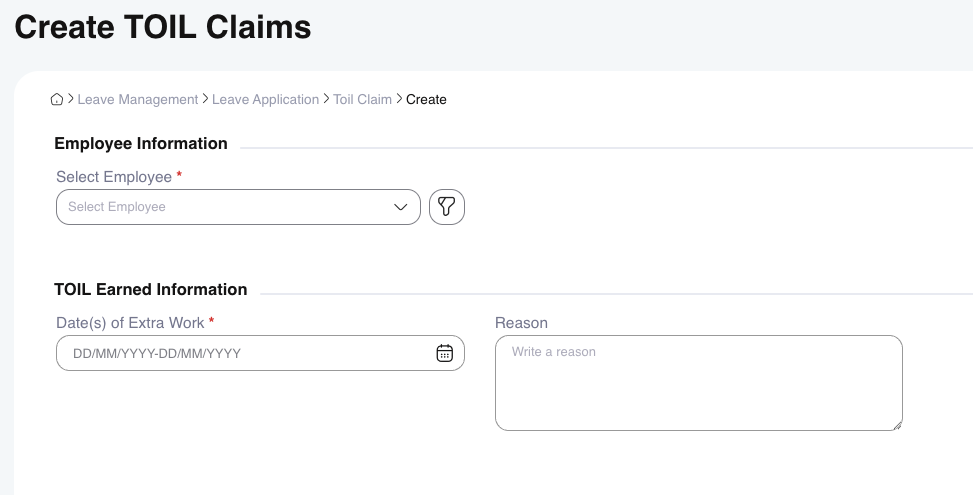
- Manual TOIL claim submission: Employees can submit requests to claim TOIL earned leave for additional hours worked on weekdays, weekends or holiday shifts. The manual claim option provides flexibility and helps ensure all eligible leaves are formally reviewed and recorded in line with company policies.
Refer to the screenshot below to see how employees can manually claim TOIL within infithra:
- Configurable approval workflows: TOIL claims often require review and approval before being processed. infithra provides configurable approval workflows that guide requests through the appropriate authorization process. Each claim follows a structured approval path defined by the organization. This approach improves accountability and ensures every request receives proper review.
- Configurable TOIL rules: infithra allows organizations to define TOIL rules based on specific business requirements. HR teams can configure how compensatory leave is calculated across different scenarios, such as working days, non-working days or holidays.
Refer to the screenshot below to see how you can set it up within infithra:
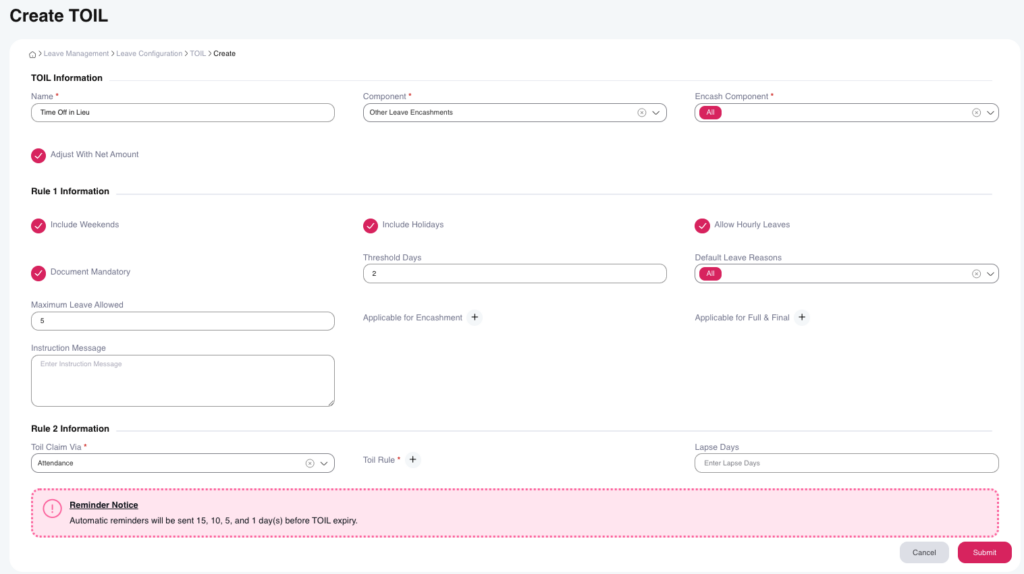
The system supports flexible duration settings and custom TOIL ratios, enabling organizations to align leave accrual with internal policies.
Refer to the screenshot below to view the outcome of the above configuration within infithra:
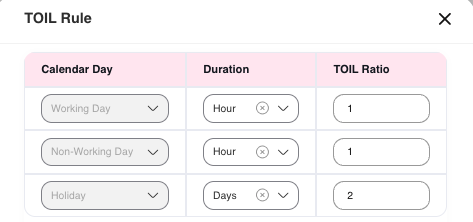
This rule-based configuration ensures TOIL is granted in a structured and consistent manner, even across diverse workforce setups common in the UAE and GCC.
- Employee self-service access: Employees can submit and track TOIL claims directly through infithra’s employee self-service portal. Using the mobile app, employees can view earned compensatory leave and check their available balances. This transparency helps employees stay informed and reduces routine queries directed to HR teams.
- Notifications and expiry management: Unused TOIL may expire if employees do not use their leave within the allowed period. infithra helps manage this through automated reminders and notifications. The system alerts employees, managers and HR teams about upcoming expiry dates. This ensures compensatory leave is used appropriately and records remain accurate.
infithra helps organizations manage time off in lieu through a structured and automated process. The platform reduces manual work while improving transparency and policy compliance.
With automated tracking, configurable rules and self-service access, HR teams can manage compensatory leave more efficiently and maintain accurate records across the workforce.
Final thoughts
Managing Time Off in Lieu effectively requires more than just policy definition. It demands consistency, visibility and control across the entire process.
As workforce structures become more dynamic in the UAE, manual methods can limit accuracy and slow down decision-making. A structured approach helps organizations maintain clarity while supporting both employee expectations and operational needs.
The real value of TOIL lies in how seamlessly it is managed. When supported by the right systems, it becomes a reliable tool for balancing flexibility with accountability.
Intrigued to see how infithra can simplify and automate your TOIL management? Schedule a demo now and experience its capabilities in action.

FAQs
1. What does TOIL mean in work?
Time off in lieu refers to compensatory leave granted to employees for extra hours worked instead of additional pay. It allows employees to take time off at a later date for additional effort contributed beyond their standard working hours.
2. Is Time Off in Lieu legal in the UAE?
In the UAE, TOIL is legally recognized under Federal Decree Law No. 33 of 2021, but with an important condition. While extra hours worked on public holidays entitle employees to either double pay or a compensatory day off, this must be based on mutual agreement; employers cannot unilaterally substitute pay with leave. TOIL policies must therefore be clearly documented in employment contracts or internal HR policies to remain compliant.
3. What are the maximum working hours allowed under the UAE labour law?
Under Federal Decree Law No. 33 of 2021, UAE private sector working hours are capped at 8 hours per day and 48 hours per week. Certain sectors, including hotels, cafes and security services, may extend this to 9 hours daily with MoHRE approval. Ramadan reduces hours by 2 hours per day for all employees. Additional working hours are limited to 2 additional hours per day. TOIL policies must operate within these statutory limits.
4. How is TOIL different from annual leave?
Annual leave is pre-scheduled paid leave for personal use, while TOIL is earned as compensation for extra hours worked. TOIL accrual is tied to additional work hours rather than standard leave entitlements.
5. How do you calculate and track time in lieu accurately?
Accurate TOIL calculation requires tracking additional work hours, setting accrual rates and applying usage limits. infithra automates this process with flexible TOIL rules, automated or manual claims, configurable approvals, self-service access and smart reminders, ensuring precise and compliant tracking of compensatory leave.
6. Do you get paid for lieu days?
Lieu days are typically taken as time off instead of cash. However, unused TOIL may sometimes be converted into pay upon resignation or as per company policy.
7. How does TOIL apply to shift-based industries in the UAE?
In shift-based sectors such as retail, hospitality and healthcare, employees follow rotating schedules that often extend beyond standard working hours. TOIL policies must account for irregular rest days and varied shift patterns. Under the UAE Labour Law, night shift differentials may not apply to certain shift roles. HR teams must clearly define eligibility to ensure consistency and compliance.
8. How should construction and logistics companies in the UAE manage TOIL?
Construction and logistics workers in the UAE frequently work extended hours to meet deadlines. However, a critical sector-specific rule applies: outdoor work under direct sunlight is prohibited between 12:30 PM and 3:00 PM from June 15 to September 15. This mid-day break directly affects how shifts and additional working hours are structured. TOIL policies in these sectors must account for this mandatory restriction, ensuring accumulated hours are accurately recorded within legally compliant scheduling frameworks.
Leave a Reply