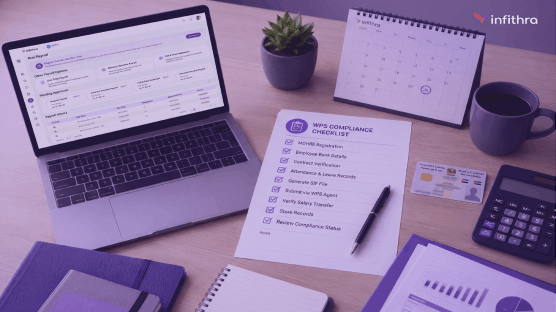
Picture this. It’s the last week of the month, payroll is almost ready, and then someone spots a mismatched IBAN in the SIF file two hours before the bank cutoff. If that scenario feels familiar, you already know why WPS compliance deserves more attention than a quick checkbox at month-end.
The rules around the Wage Protection System changed in a real way during 2026. The old grace period is gone. MOHRE now watches salary payments almost as they happen. And a single missed cycle can be enough to freeze new work permits for your entire company. For HR and payroll teams across the UAE, that raises the stakes on getting this right, every single month, not just occasionally.
This guide walks through what WPS actually is, who needs to register, how the salary transfer process works, what goes into a SIF file, and where employers tend to slip up. We’ll also cover the penalties that follow non-compliance and how payroll software, including infithra, takes a lot of the manual guesswork out of staying compliant.
One thing worth saying upfront. MOHRE updates WPS rules from time to time, and this guide reflects the framework in place around mid-2026. Treat it as a solid starting point, not a substitute for checking directly with MOHRE or a UAE employment advisor before making compliance decisions for your organization.
What is the Wage Protection System (WPS) in the UAE?
WPS, short for the Wage Protection System, is the electronic salary transfer mechanism the UAE Ministry of Human Resources and Emiratisation uses to make sure private sector employees actually get paid what their contracts say. Instead of handing out cash or moving money through informal channels, employers route wages through banks, exchange houses, or other institutions approved by the Central Bank of the UAE.
Every payment made this way leaves a digital footprint MOHRE can review. That footprint is really the whole point. It’s what turns “trust me, I paid them” into a verifiable record, and it’s the backbone of what people often call the salary protection system in the UAE.
WPS isn’t new. It goes back to Ministerial Decree No. 788 of 2009. Since then, the rules have been revised more than once, most recently through Ministerial Resolution No. 340 of 2026, which took effect on 1 June 2026 and replaced the earlier Resolution No. 598 of 2022.
Why Was WPS Introduced?
Before WPS existed, wage disputes in the UAE were common, and proving what actually happened was hard. An employee might claim they were underpaid or not paid at all, and without a paper trail, it often came down to one party’s word against another’s.
WPS closed that gap. Once every salary payment runs through an approved financial channel, MOHRE gets a transparent, timestamped record of who got paid, how much, and when. That protects workers from being shortchanged, gives the Ministry an early warning system when something looks off, and honestly, it also protects compliant employers, who now have a clean paper trail if a dispute ever lands on their desk.
Who Must Register for WPS?
Short answer: almost everyone. As of 2026, every private sector mainland establishment registered with MOHRE needs to be on WPS, no matter how many people they employ. A five-person startup and a five-thousand-person enterprise fall under the same expectation here.
Free zone companies are largely expected to follow WPS too, JAFZA included, though the fine print on enforcement can shift slightly depending on the free zone authority. DIFC and ADGM are the notable exceptions, since they run their own separate wage protection frameworks rather than plugging into the standard MOHRE system.
A handful of categories sit outside WPS requirements under the current resolution:
- Employees with wage-related claims already before the courts, limited to the scope of that specific claim
- Workers reported absent through an approved work abandonment report.
- Staff on mission work permits lasting three months or less.
- Foreign workers employed by foreign establishments who are paid outside the UAE, where MOHRE has approved this, and the worker has agreed to it.
- A few individually owned setups, such as fishing boats and public taxis
- Banks, financial institutions, and places of worship
Here’s a change worth flagging clearly, because a lot of outdated guidance still floats around online. New hires used to get a 30-day grace window before WPS applied to them. That exemption is gone under the 2026 resolution. New employees are now covered from day one of employment.
How Does WPS Salary Transfer Work?
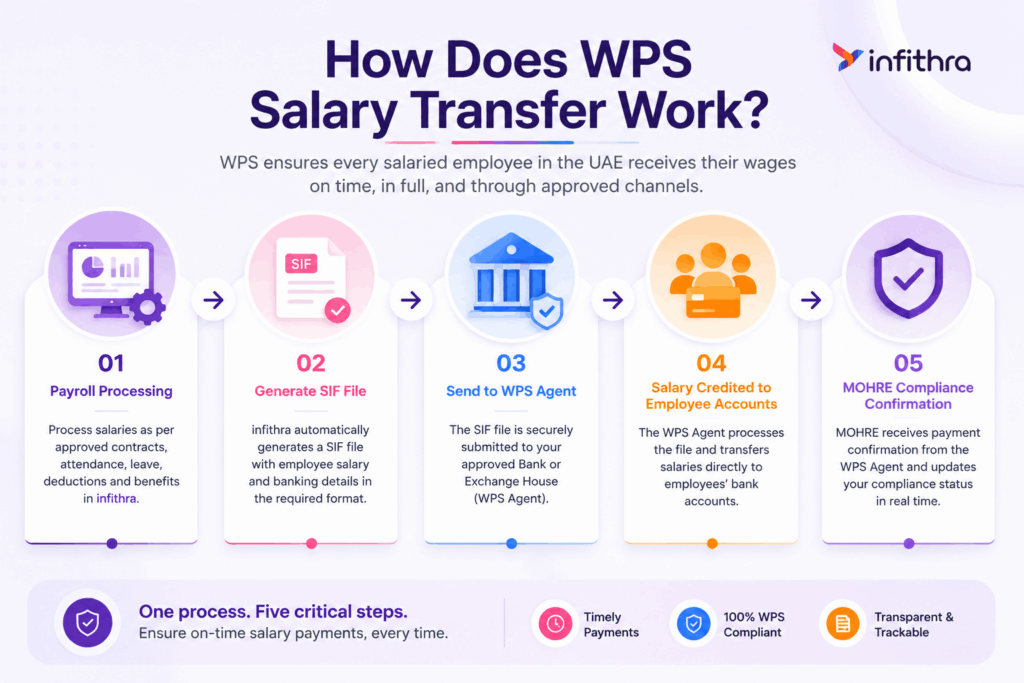
The mechanics behind WPS salary transfer follow roughly the same rhythm every month, regardless of company size.
- Payroll calculates salaries for the period, factoring in basic pay, allowances, and any deductions that apply.
- That data gets compiled into a Salary Information File, or SIF file, formatted according to Central Bank of the UAE specifications.
- The SIF file goes to an approved WPS agent, usually a bank or exchange house the company already works with.
- The agent processes it and deposits salaries into each employee’s bank account or WPS-linked salary card.
- MOHRE receives confirmation and updates the employer’s compliance record accordingly.
Since Ministerial Resolution No. 340 of 2026 came into force, wages for a given Gregorian month need to clear through WPS by the first day of the next month. There’s no more 15-day buffer to lean on. Employers are generally considered compliant if at least 85 percent of total wages due go out on time, but dip below that threshold and enforcement action starts kicking in fairly quickly.
Understanding the WPS SIF File Format
If WPS has a technical heart, it’s the SIF file. It’s a plain comma-separated text file, no header row, built from two kinds of entries.
The very first line is always the Employee Detail Record, or EDR . Think of it as the cover sheet. It identifies the employer through their MOHRE-issued establishment ID, states which salary month is being paid, and totals up the number of employees and the overall amount included in the file.
Every line that follows is a Salary Control Record, or SCR, one per person being paid. A typical EDR line includes:
- The employee’s Ministry-issued ID number
- A routing code identifying the bank or exchange house holding their account
- Their UAE IBAN or salary card number
- Start and end dates for the pay period
- Number of days actually worked in that period.
- The salary breakdown, covering fixed pay, any variable pay or allowances, and leave deductions
Even the filename follows a strict pattern, usually combining the employer’s MOHRE ID with the date and time the file was created. And here’s where a lot of files get rejected. A wrong IBAN check digit, or an employee count on the SCR line that doesn’t match the actual number of EDR lines beneath it, is often all it takes to bounce a submission back. Getting the format right matters just as much as hitting the deadline.
WPS Compliance Requirements Every Employer Should Know
Staying compliant isn’t just about hitting submit once a month and moving on. A few obligations sit underneath that single action.
Register with MOHRE
An active MOHRE registration has to exist before a company can even participate in WPS. This registration links the establishment’s labour file to its salary records, so MOHRE WPS registration should happen early in the payroll setup process, not as something you circle back to later.
Use an Approved WPS Agent
Wages need to move through a bank, exchange house, or financial institution officially approved to handle WPS payments. Paying an employee through an unapproved route, even if the money physically reaches them, doesn’t count as compliant and won’t show up correctly in MOHRE’s records.
Pay Salaries on Time
The salary transfer system UAE employers now operate under has no grace window left. Wages need to clear by the first day of the month following the pay period. Building in a habit of finishing payroll a few days early, rather than racing the deadline, gives teams breathing room if a bank hiccup or technical glitch shows up unexpectedly.
Submit Accurate Payroll Data
Every SIF file has to line up with what’s actually in the employee’s contract, from basic salary to allowances to legitimate deductions. A mismatch between contract data and what’s submitted is one of the more common reasons MOHRE flags a file, even when the payment itself technically went out on time.
Maintain Payroll Records
Keeping organized records of payments, SIF submissions, and bank confirmations isn’t just good housekeeping. Those records become evidence if an internal audit, wage dispute, or MOHRE inquiry ever comes up.
Ensure Employee Contract Alignment
Whatever runs through WPS has to match the employee’s MOHRE-registered labour contract. When someone gets a raise, a new allowance, or a role change, the contract and the payroll system both need updating together, not one after the other with a gap in between.
UAE Labour Law and Salary Payment Requirements
WPS doesn’t operate in isolation. It sits inside a broader set of UAE labour law and salary payment requirements. Federal labour law calls for wages to be paid in UAE dirhams, in full, on the schedule agreed in the employment contract, which is typically monthly.
Employers are also expected to issue clear, itemized payslips, and any deductions, whether for accommodation, loans, or something else, need to be lawful, documented, and something the employee actually agreed to. Payment obligations don’t pause during notice periods, and where gratuity or end-of-service benefits apply, those need to be calculated and settled based on the employee’s tenure and contract type.
Since WPS payment data feeds directly into MOHRE’s wider labour compliance monitoring, a steady salary payment history tends to make other processes smoother too, things like visa renewals, labour card issuance, and Emiratisation reporting.
Common WPS Compliance Mistakes
Most WPS problems aren’t dramatic. They’re small, avoidable process gaps that pile up over time:
- SIF files submitted with outdated or incorrect employee bank details
- Salaries paid a few days late because processing started too close to the deadline.
- SIF figures that don’t quite match the employee’s registered contract salary
- Forgetting to update WPS records after an employee changes banks or gets a new salary structure
- Assuming new employees still get a 30-day grace period, based on outdated advice from before the 2026 update
- Leaning on manual spreadsheets for payroll, which quietly increases the odds of a formatting error that bounces a file
Non-Compliance WPS Penalties
Since the 2026 resolution took effect, non-compliance WPS penalty enforcement has become noticeably faster and stricter. Rather than one flat fine, penalties tend to escalate in stages the longer wages go unpaid:
- An early notification from MOHRE flags the establishment’s compliance status
- Continued delay can lead to a freeze on new work permits, which stops the company from hiring.
- Further delay brings financial fines and a drop into a lower compliance category, affecting future permit approvals and access to government services.
- Extended non-payment can trigger labour dispute registration on behalf of affected employees.
- In the most severe cases, enforcement can escalate to asset attachment and referral to Public Prosecution.
Fines are generally applied per affected employee, and the specific amounts and timelines are the kind of thing MOHRE adjusts as enforcement evolves. Given how often these figures shift, it’s worth confirming current penalty details directly with MOHRE rather than relying on numbers published months or years ago.
Best Practices for Maintaining WPS Compliance
Staying on top of WPS consistently, instead of scrambling every month, usually comes down to a handful of habits:
- Run payroll early enough in the cycle to leave buffer time before the deadline.
- Reconcile employee bank details and contract terms on a regular schedule, not only when something obviously changes.
- Give someone on the payroll team clear ownership of SIF generation and submission.
- Keep a compliance calendar built around current MOHRE deadlines, not assumptions carried over from last year.
- Automate SIF file generation wherever you can to cut down on manual formatting mistakes
- Check MOHRE’s compliance dashboard regularly instead of waiting for a notification to show up first.
How Payroll Software Simplifies WPS Compliance
Manual WPS handling can work fine for a very small team, but the risk climbs fast as headcount grows. This is where good payroll software UAE businesses rely on earns its keep, by automating the exact steps most prone to human error.
A solid automated payroll solution builds SIF files straight from verified payroll data, which removes most of the manual formatting slip-ups that lead to bank rejections. It also catches inconsistencies early, like a mismatch between an employee’s contract salary and what’s actually being processed, before the file ever gets submitted.
Beyond the SIF file itself, payroll software helps HR and finance teams keep pace with MOHRE payroll regulations as they shift, hold onto organized digital records for audits, and finish payroll early enough that deadline pressure stops being a monthly source of stress. For businesses running operations across the UAE, Abu Dhabi, and Saudi Arabia, that same automation keeps payroll consistent across different labour law requirements instead of forcing separate manual processes for each location.
How infithra Helps HR and Payroll Teams Stay WPS Compliant
infithra is built to take a lot of that manual risk off the table for HR and payroll teams across the UAE, Saudi Arabia and GCC.
With infithra’s payroll management software, teams can generate accurate, WPS-compliant SIF files straight from verified payroll data, cutting down on the formatting errors that lead to bank rejections and late payment flags.
Because WPS compliance hinges on accurate employee and contract data, infithra’s HRMS for UAE businesses keeps employment terms, salary structures, and personal records centralized and current, so payroll always reflects what’s actually written into the contract.
When contract details, promotions, or role changes happen, infithra’s automated payroll solution keeps employee records synced with payroll automatically, closing the gap between HR updates and salary processing that so often causes SIF mismatches.
Getting WPS payroll system output right also depends on correct working hours and leave data. infithra’s attendance management system and leave management software feed clean, verified hours and leave deductions straight into payroll, cutting down on manual reconciliation before every SIF submission.
For HR leaders who want visibility beyond a single payroll run, infithra’s people analytics platform offers reporting on payroll trends, compliance history, and workforce data, giving teams the oversight to catch potential issues before they turn into a MOHRE flag.
WPS Compliance Checklist for HR Teams
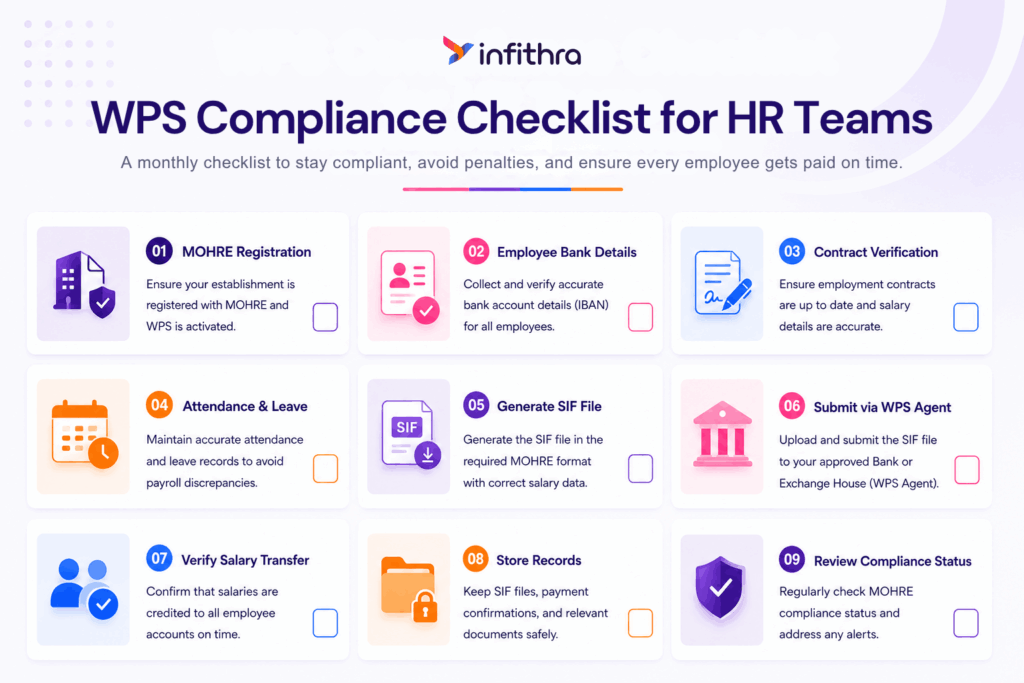
Keep this checklist handy as a quick monthly reference for staying on top of WPS compliance requirements:
- Confirm MOHRE registration is active and current.
- Double-check that employee bank details and IBANs are up to date.
- Cross-check SIF salary figures against active employment contracts
- Confirm attendance and leave deductions are reflected accurately in payroll.
- Generate and validate the SIF file before submitting it.
- Send the SIF file through an approved WPS agent well ahead of the monthly deadline.
- Confirm successful transfer with the bank or exchange house.
- Store payment confirmations and SIF records for audit purposes
- Check MOHRE’s compliance dashboard for any flags or notifications.
- Update payroll records right away whenever contracts, salaries, or bank details change.
Key Takeaways
- WPS is the mandatory electronic salary transfer system that gives MOHRE a transparent, verifiable record of wage payments across UAE private sector employers.
- Under Ministerial Resolution No. 340 of 2026, the old grace period is gone, and wages now need to clear through WPS by the first day of the following month.
- Nearly every private sector establishment must comply, and the previous 30-day exemption for new employees no longer applies.
- The SIF file, made up of one SCR summary record and individual EDR employee records, is the technical core of every WPS submission, and small formatting errors remain a leading cause of rejection.
- Non-compliance penalties escalate quickly now, moving from MOHRE notifications to work permit freezes, fines, and in severe cases, legal action.
- Payroll software meaningfully lowers WPS compliance risk by automating SIF generation, keeping contract and payroll data aligned, and maintaining audit-ready records.
- infithra’s connected HR and payroll tools help UAE, Saudi Arabia, and GCC based teams stay compliant without depending on manual spreadsheets or disconnected systems.
Ready to Simplify WPS Compliance for Your Business?
WPS compliance isn’t a once-a-year project. It’s a monthly obligation that depends on accurate data, timely processing, and systems that actually talk to each other instead of working against one another. If your HR and payroll teams are still handling WPS by hand, it might be worth changing that before the next deadline puts your compliance record on the line.
Here’s a quick look at how infithra supports UAE, Saudi Arabia and GCC based businesses beyond WPS compliance alone:
- Payroll management software: Automated, WPS-compliant payroll runs with SIF file generation built in.
- HRMS for UAE businesses: One centralized system for employee records, contracts, and compliance data.
- Automated payroll solution: Keeps employee lifecycle changes synced with payroll automatically.
- Attendance management system: Accurate working hours feeding directly into every payroll cycle.
- Leave management software: Clean leave data with no manual reconciliation before payroll runs.
- People analytics platform: Reporting and insights that help HR teams stay ahead of compliance risk.
Schedule a free demo with infithra today and see how your HR and payroll teams can move from reactive WPS management to confident, automated compliance.
Frequently Asked Questions (FAQ)
1. What is the Wage Protection System (WPS) in the UAE?
The Wage Protection System is MOHRE’s mandatory electronic salary transfer mechanism, requiring UAE private sector employers to pay wages through approved banks or exchange houses. It creates a digital, auditable record of every salary payment, which MOHRE relies on to monitor labour law compliance across the private sector.
2. Is WPS mandatory for all employers in the UAE?
Yes. WPS applies to all UAE private sector mainland establishments registered with MOHRE, regardless of size, and most free zone employers follow the same system as well. A small set of specific categories, such as banks, places of worship, and certain individually owned businesses, are exempt under current MOHRE rules.
3. What is a WPS SIF file and how is it generated?
A SIF file, or Salary Information File, is the standardized payroll file UAE employers submit every cycle to process salaries through WPS. It contains a summary Salary Control Record followed by individual Employee Detail Records for each staff member, and it’s typically generated directly from payroll software using verified employee and salary data.
4. What happens if an employer fails to comply with WPS requirements?
Non-compliance sets off escalating enforcement, starting with an MOHRE notification and potentially moving to a freeze on new work permits, financial fines, compliance reclassification, and in serious or prolonged cases, labour dispute registration or legal action. Exact penalties and timelines are set by MOHRE and should be confirmed directly for current figures.
5. How can payroll software help organizations stay WPS compliant?
Payroll software lowers WPS compliance risk by generating accurate SIF files automatically, cross-checking payroll data against employee contracts, and keeping organized digital records for audits. Platforms like infithra also connect HR, attendance, and leave data to payroll, which reduces the manual errors that most often cause compliance issues.
Leave a Reply