
Ask any HR leader in the UAE, Abu Dhabi, Saudi Arabia, KSA, Qatar, Bahrain, Oman, or Kuwait what keeps them up at night, and talent retention is usually near the top of the list. Skilled professionals across the GCC have options, and they are no longer staying in jobs out of habit. They stay because the workplace genuinely works for them.
That is why employee experience and employee engagement have become two of the most talked about topics in HR strategy. They are not interchangeable ideas, nor passing trends. Together, they shape whether people show up motivated or show up, whether they stay for years or start browsing job boards within months.
This article breaks down what employee experience and engagement actually mean, why employee experience matters so much to business outcomes, and what practical strategies HR teams can use to improve both. Along the way, we will look at how the right HR technology, such as infithra, turns these ideas into everyday reality rather than leaving them as slide deck concepts.
What is Employee Experience?
Employee experience is best understood as the full story of an employee’s relationship with an organization. It starts before someone even accepts a job offer and continues through every interaction they have until the day they leave.
Three environments shape that story:
- Physical environment: The office, equipment, and everyday workplace facilities employees rely on.
- Digital environment: HR platforms, communication tools, and self-service systems used for daily tasks.
- Cultural environment: Leadership behaviour, company values, recognition habits, and how teams treat one another.
When these three environments work in harmony, employees feel supported at almost every touchpoint, not only during a big onboarding event or an annual review. That consistency is what separates a genuinely good employee experience from one that only looks good on paper.
What is Employee Engagement?
If employee experience is the story, employee engagement is how the employee feels about being part of it. It is the emotional and mental commitment someone has toward their work and their organization’s goals.
Engaged employees tend to bring energy to their tasks, speak up with ideas, and put in effort that goes beyond the bare minimum of their job description. They are also far less likely to be quietly job hunting on the side.
HR teams typically track engagement through job satisfaction scores, survey feedback, participation in company initiatives, and employee Net Promoter Score, often shortened to eNPS. These numbers matter, but they only tell part of the story unless they are read alongside what is actually happening in the employee experience.
Employee Experience vs Employee Engagement
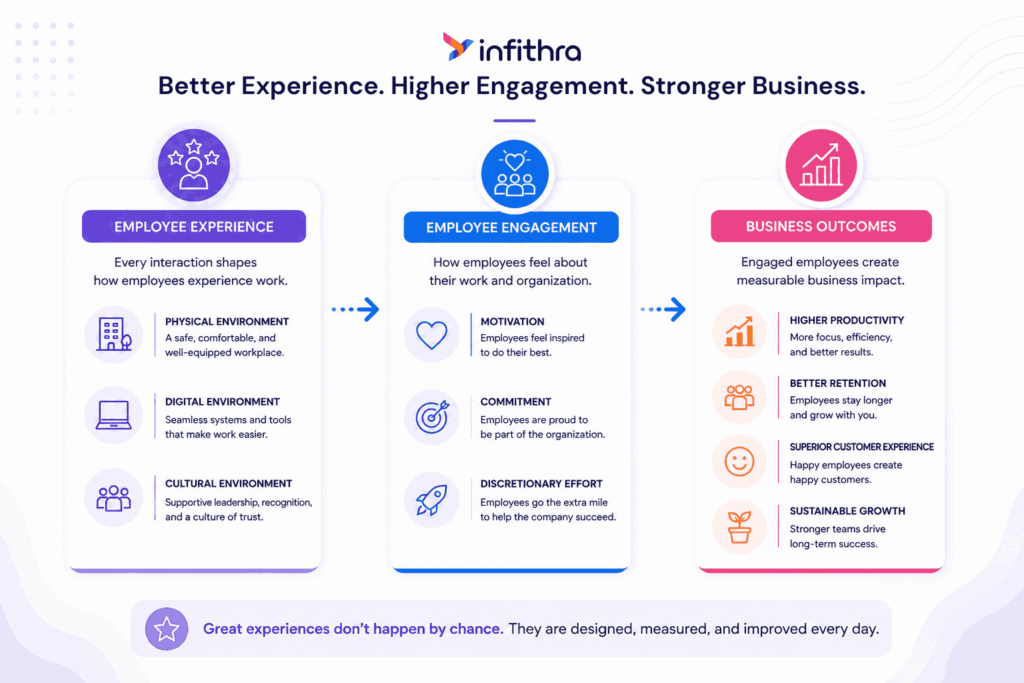
These two terms get used as if they mean the same thing, but they describe different parts of the same picture.
| Aspect | Employee Experience | Employee Engagement |
| Definition | Every interaction and touchpoint an employee has with the organization | The emotional commitment and motivation an employee brings to their work |
| Focus | Systems, culture, and organizational design | Individual attitude, energy, and discretionary effort |
| Ownership | Shaped by HR, leadership, IT, and facilities teams | Influenced heavily by managers, recognition, and communication |
| Measurement | Journey mapping, touchpoint audits, exit interviews | Engagement surveys, pulse checks, eNPS scores (employee Net Promoter Score) |
| Outcome | Builds the foundation of the workplace | Reflects how employees respond to that foundation |
Think of it this way. Experience is what the organization builds. Engagement is how employees react to what has been built. Businesses that pour resources into engagement campaigns while ignoring a clunky, frustrating employee experience rarely see results that last. Fix the foundation first, and engagement tends to follow more naturally.
Why Employee Experience Matters
Employee experience touches almost every part of a business, from how quickly you can hire good people to how those people treat your customers. Here is why it deserves serious attention across organizations in the UAE, Abu Dhabi, Saudi Arabia, KSA, Qatar, Bahrain, Oman, and Kuwait.
Better Employee Retention
When employees feel heard and supported, they simply have less reason to leave. In competitive GCC job markets, where a strong candidate might have two or three offers on the table, a positive employee experience can be the deciding factor between staying and walking away. Retaining people is almost always cheaper and less disruptive than replacing them.
Improved Productivity
Give employees the right tools, clear processes, and managers who actually support them, and they can focus on real work instead of fighting outdated systems or chasing paper approvals. This is where the link between engagement and productivity becomes obvious. Remove the friction, and output tends to rise on its own.
Better Customer Experience
Employees who feel genuinely valued carry that energy into how they treat customers. This connection is especially visible in customer-facing sectors that are common across the UAE, Saudi Arabia, KSA, Qatar, Bahrain, Oman, and Kuwait, including retail, hospitality, and banking. A frustrated, disengaged employee rarely delivers a great customer interaction, no matter how good the training was.
Stronger Company Culture
Every experience an employee has, good or bad, quietly reinforces or erodes the culture leadership is trying to build. Consistent, positive experiences build trust between employees and the organization, and over time that trust becomes the company’s identity, the kind that attracts talent rather than repelling it.
Higher Employee Wellbeing
A well-designed employee experience supports mental and physical wellbeing rather than working against it. That means manageable workloads, genuine flexibility, and a culture that does not quietly reward burnout. Organizations that invest in employee wellbeing initiatives usually notice fewer sick days or absences and steadier morale across teams.
Better Innovation
People share better ideas when they feel safe enough to say something that might not work. A positive employee experience builds that psychological safety, which is often the missing ingredient behind stalled innovation. Employees who trust their environment speak up more, and some of those conversations turn into real improvements.
Increased Business Growth
Put all of this together, and the pattern becomes clear. Lower turnover means lower hiring costs. Higher productivity means better output. Happier customers mean repeat business. A culture that welcomes new ideas stays competitive longer. Employee experience is not a soft HR metric sitting on the sidelines. It is directly connected to business growth.
How Employee Experience Impacts Retention
Retention rarely collapses overnight. It usually erodes slowly, and employee experience is often the reason why.
Most employees do not quit the moment something goes wrong. They disengage first. Maybe onboarding felt disorganized, or leave requests keep getting lost, or there is no visible path to a promotion. Dissatisfaction builds quietly, and by the time someone hands in their resignation, they have usually been mentally checked out for a while.
A strong employee experience interrupts that slide at several points:
- Onboarding: A structured, welcoming start helps new hires feel confident and connected from day one, which reduces early exits.
- Day-to-day operations: Reliable HR management software cuts down on daily frustration around leave requests, payslips, and approvals.
- Career development: Employees who can actually see a future at the company are far more likely to stick around and invest in it.
- Recognition: Regular, genuine acknowledgment reinforces and feedback that someone’s work matters, and that feeling is closely tied to loyalty.
- Exit feedback: Even when people do leave, structured exit interviews help HR catch experience gaps before they cost the next hire too.
Organizations that treat retention as a downstream result of experience, instead of trying to patch it with a pay raise every time someone threatens to quit, tend to build teams that stay engaged for the long run.
Employee Engagement Strategies for HR
Good intentions are not enough. HR teams need strategies they can actually repeat and measure. These are the approaches that consistently move the needle.
Continuous Feedback
Waiting a full year to tell someone how they are doing does not work anymore. Continuous feedback through regular one-on-ones and informal check-ins lets managers catch problems early and recognize good work while it is still fresh, not months later when it barely registers.
Employee Recognition Programs
Whether it is peer-to-peer shoutouts or manager-led recognition, structured programs reinforce the behaviour you want to see more of. Recognition does not need to be elaborate. Consistency matters more than grandeur.
Career Development
People stay where they can see themselves growing. Mentorship, upskilling opportunities, and clear promotion criteria all help employees connect what they do today with where they could be in a couple of years.
Digital HR Platforms
Modern HR management software brings communication, requests, and updates into one place instead of scattering them across emails and spreadsheets. Less administrative friction usually means a smoother, more consistent employee experience overall.
Employee Self-Service
Letting employees manage their own leave requests, update personal details, or pull documents without waiting on HR builds a real sense of autonomy. It also frees up HR teams to spend time on work that actually needs a human.
Personalized Learning
Generic, one-size-fits-all training tends to fall flat because it ignores what an individual employee actually needs. Personalized learning paths, tied to real skill gaps and career goals, see noticeably better completion rates and engagement.
Performance Management
Vague expectations breed disengagement faster than almost anything else. Clear goals, fair evaluation criteria, and a transparent process help employees understand exactly how their work is being judged, which removes a lot of unnecessary anxiety.
Regular Surveys
Pulse surveys and periodic engagement checks give HR a direct line into how people are really feeling. The catch is that surveys only build trust when employees can see their feedback actually changing something. A survey that goes nowhere does more harm than good.
Leadership Communication
Employees want to understand where the company is heading and how decisions affect them. Leadership communication that is honest and consistent builds trust, especially during periods of change, restructuring, or growth. Silence from leadership tends to get filled with speculation, and that rarely helps morale.
Flexible Work Policies
Wherever operations allow, flexibility around working hours or remote arrangements has become an expectation rather than a perk across much of the region. Reasonable flexibility often improves satisfaction without hurting output, and employees notice when a company trusts them enough to offer it.
Improving Workplace Employee Experience
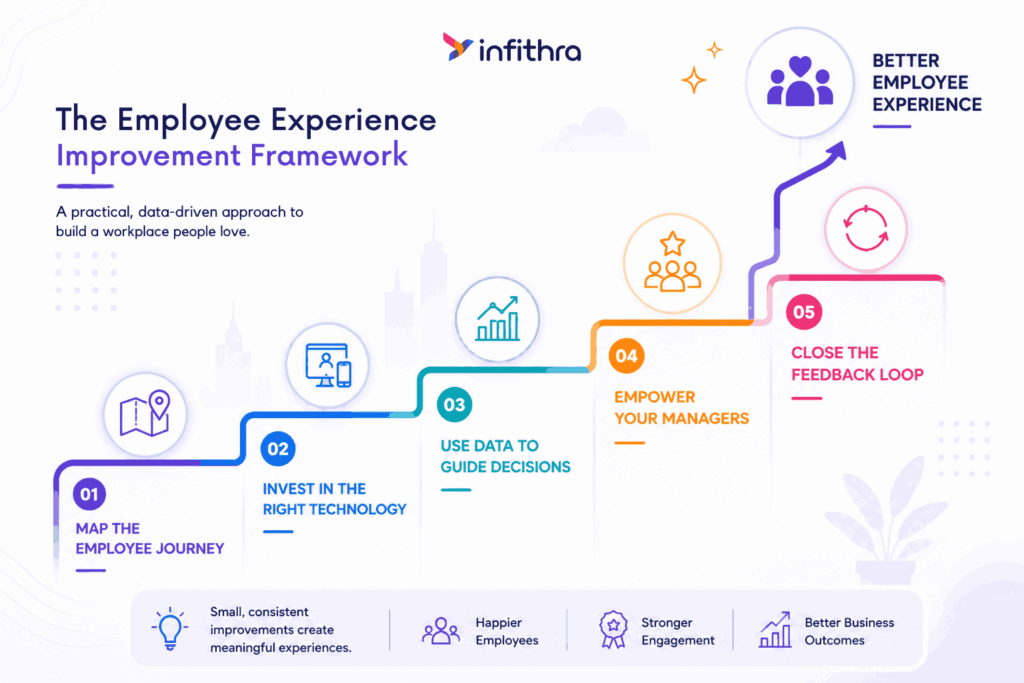
There is no single fix for employee experience. It takes a structured, ongoing approach rather than a one-off initiative that gets forgotten by next quarter. HR teams that see lasting improvement usually follow a similar playbook:
- Map the employee journey: Walk through every touchpoint from recruitment to exit and note exactly where friction or frustration tends to show up.
- Invest in the right technology: Manual, paper-based processes create delays that employees notice and resent. Digital HR platforms streamline attendance, leave, payroll, and communication in one system.
- Use data to guide decisions: HR analytics turns assumptions into evidence, revealing patterns in turnover, engagement, and performance that would otherwise stay hidden in spreadsheets.
- Train managers well: Managers shape daily employee experience more than any policy document ever will. Investing in their communication and coaching skills pays off disproportionately.
- Close the feedback loop: Employees need proof that their input leads somewhere. Otherwise, engagement efforts start to feel like a formality.
- Localize for the region: In the UAE, Abu Dhabi, Saudi Arabia, KSA, Qatar, Bahrain, Oman, or Kuwait, employee experience strategies also need to account for multicultural workforces and local compliance requirements, including WPS and gratuity calculations.
How infithra Helps Improve Employee Experience
infithra is a cloud-based HR management software built specifically for organizations across the UAE, Saudi Arabia, KSA, Qatar, Bahrain, Oman, and Kuwait, and every part of it is designed with employee experience in mind, not just HR efficiency.
With infithra HR management software, HR teams can centralize employee data, automate approval workflows, and maintain GCC-compliant records within a single system. That means less back-and-forth for HR and fewer delays for employees waiting on approvals.
The platform’s employee management feature supports the entire employee lifecycle, from onboarding through offboarding, so employees get a consistent, organized experience at every stage rather than a patchwork of disconnected processes.
Payroll accuracy has an outsized effect on trust. Get it wrong even once, and employees remember it for a long time. infithra’s payroll management feature automates multi-currency, GCC-compliant payroll runs, helping organizations avoid the errors and delays that quietly damage confidence.
To help HR leaders move from gut feeling to actual evidence, infithra’s workforce analytics provide reports on turnover trends, attendance patterns, and broader workforce insights- the kind of HR analytics that makes engagement strategies far more targeted.
Day-to-day friction around time tracking gets simpler with infithra’s attendance tracking feature, which offers smart shift and attendance and accurate working hour records without the manual chasing.
Leave requests are one of the most common daily irritations for employees, and infithra’s leave management system fixes that by letting employees submit and track requests on the go through employee self-service.
Put together, these tools help organizations build the kind of consistent, friction-free employee experience that supports real engagement and stronger retention, instead of leaving it to chance.
Future Trends in Employee Experience
Workplaces across the GCC keep evolving, and a few trends are already shaping what comes next for employee experience:
- AI-assisted HR communication: Tools that help HR teams draft announcements, policy updates, and personalized messages faster, while keeping tone and messaging consistent.
- Predictive HR analytics: Using workforce data to flag attrition risk and engagement dips before they show up in an exit interview, when it is already too late to act.
- Hyper-personalized employee journeys: Moving away from generic onboarding and development programs toward journeys shaped around individual roles and goals.
- Wellbeing as a core metric: Employee wellbeing initiatives are increasingly tracked alongside productivity and engagement, not treated as a separate, optional program.
- Unified digital experiences: Organizations are consolidating scattered HR tools into single platforms so employees have one place to manage their entire work life.
Key Takeaways
- Employee experience covers every interaction an employee has with an organization. Employee engagement reflects how they feel as a result of that experience.
- A strong employee experience directly improves retention, productivity, customer experience, culture, wellbeing, innovation, and overall business growth.
- Retention improves when organizations fix friction at every stage of the employee journey, not only through compensation.
- Effective engagement strategies combine continuous feedback, recognition, career development, flexible policies, and honest leadership communication.
- Digital HR platforms and HR analytics play a central role in spotting gaps and improving employee experience at scale.
- infithra’s suite of features, including core HR, employee management, payroll, people analytics, attendance, and leave management, helps organizations across the UAE, Abu Dhabi, Saudi Arabia, KSA, Qatar, Bahrain, Oman, and Kuwait build a stronger, more consistent employee experience.
Ready to Build a Better Employee Experience?
Employee experience and engagement are not a one-time project you launch and forget. They need the right processes, the right culture, and the right technology working together, day after day. If your organization in the UAE, Abu Dhabi, Saudi Arabia, KSA, Qatar, Bahrain, Oman, or Kuwait is ready to cut turnover, lift engagement, and simplify HR operations along the way, infithra can help you get there.
Here is a quick summary of what infithra brings to the table, all connected to the employee experience goals covered in this article:
- HR management software: A centralized system for HR data, workflows, and GCC compliance.
- Employee management solution: Consistent support across the full employee lifecycle, from onboarding to offboarding.
- Payroll software: Accurate, GCC-compliant, multi-currency payroll that builds employee trust.
- Workforce analytics: HR analytics that turn workforce data into decisions you can actually act on.
- Attendance tracking software: Smart, accurate time tracking without the manual chasing.
- Leave management system: Self-service leave requests that remove one of the most common daily frustrations for employees.
- Performance management system (Coming soon): Manage your entire team’s performance on a unified dashboard.
Schedule a free demo with infithra today and see how the right HR platform can transform your employee experience from the inside out.
Frequently Asked Questions (FAQ)
1. Why does employee experience matter for business success?
Employee experience matters because it directly shapes retention, productivity, and customer satisfaction. When employees have positive, low-friction experiences at work, they engage more, perform better, and stay longer, which lowers hiring costs and supports steadier business growth.
2. How does employee experience impact employee retention?
Employee experience impacts retention by shaping how supported employees feel at every stage of their journey, from onboarding through daily operations and career growth. Poor experiences, such as disorganized onboarding or unreliable HR processes, lead to gradual disengagement and eventual turnover, while positive experiences build loyalty over time.
3. What is the difference between employee experience and employee engagement?
Employee experience refers to the interactions and touchpoints an employee has with an organization, including its systems, culture, and environment. Employee engagement is the emotional commitment and motivation an employee feels as a result of that experience. Experience is the foundation. Engagement is usually the outcome.
4. What are the best employee engagement strategies for HR teams?
Effective employee engagement strategies include continuous feedback, structured recognition programs, career development opportunities, transparent leadership communication, personalized learning, regular engagement surveys, and flexible work policies. Consistency and genuine follow-through on employee feedback are what make these strategies actually work.
5. How can HR software improve workplace employee experience?
HR software improves workplace employee experience by cutting manual administrative work, centralizing communication, and giving employees self-service access to leave, attendance, and payroll information. Platforms like infithra also provide HR analytics that help teams spot experience gaps and make data-driven improvements instead of relying on guesswork.
Leave a Reply